Have you ever wondered why you're able to pick up certain skills or concepts more quickly or easily compared to others? Have you ever been jealous that your friend is able to learn languages faster than you no matter what you seem to try? This is because everyone has a natural inclination towards certain skills, and they gravitate towards activities and professions that complement those skills.
This can also be attributed to one's unique learning style where abilities that work well with a certain learning style might be grasped and retained faster compared to others. Today we will briefly look at a common model for grouping these different styles together called the VARK model.
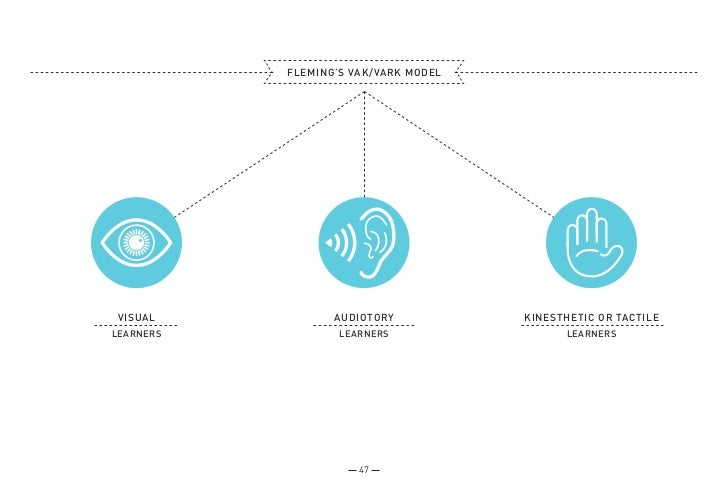
VAK model where the learning styles or modalities are broken down into visual, auditory, and kinesthetic, as well as the representational systems in neuro-linguistic programming, Fleming refined the definition of a visual learner to include an additional group; the read/ write group. This type of learner is someone who responds well to visual aids but not necessarily respond well to visual aids of the written word that lack the color and shape cues. Through his work, his team developed a questionnaire to help identify an individual’s learning style. To help us illustrate the differences between each learning style in the VARK model, let's create a simple scenario; teaching someone how to get to the post office to mail a letter.
Now you might be asking, “but what if I’m somewhere in between these learning styles?” or “I find that I am a different learning style depending on what I am learning, where do i fit?" The VARK model accounts for this through the use of multimodality. Life is complex, and so are we, and often a given task might be completed most effectively through mixing the styles. In the VARK model there are two types of multimodalities.
VARK type 1, these learners select one of their modalities that they are most comfortable with in a context specific manner.
VARK type 2 differentiates itself from type 1 in that type 2 learners require that all of their learning styles must be utilized before they are able to complete a given task.
These learners might be seen as slower as they gather information in different ways, or may appear to procrastinate. Although some may view this as negative, however, it is often the case that these learners are able to solve problems more effectively since they have a greater understanding of the task, having looked at it using different learning techniques. If you want to try the VARK test for yourself or learn more information,
Comments
Post a Comment
If you have any doubts and questions, Let me know..